
Last Updated: March 8, 2026
Types of topographic surveys for land development plays a critical role in property management and development in Florida. Understanding the different types of topographic survey methods is essential for engineers, architects, and land developers working in Florida. Each type of topographic survey provides an accurate representation of existing terrain, helping professionals determine the most efficient layout for a project. While these surveys may seem straightforward, their applications are far-reaching and critically important.
That said, did you know that there are many types of topographic surveys? That’s true! Let’s talk about that. But first, let’s discuss what a topographic survey is:
Topographic Surveys: Types Land Development
A topographic survey is a type of survey that is conducted to obtain information about the surface features of a particular area. It is used to create a detailed map of the land, which includes elevation, slope, contours, and natural and manmade features. Topographic surveys are used to create detailed maps for various purposes, such as engineering, construction, and land-use planning.
For more information, see the USGS topographic mapping resources.
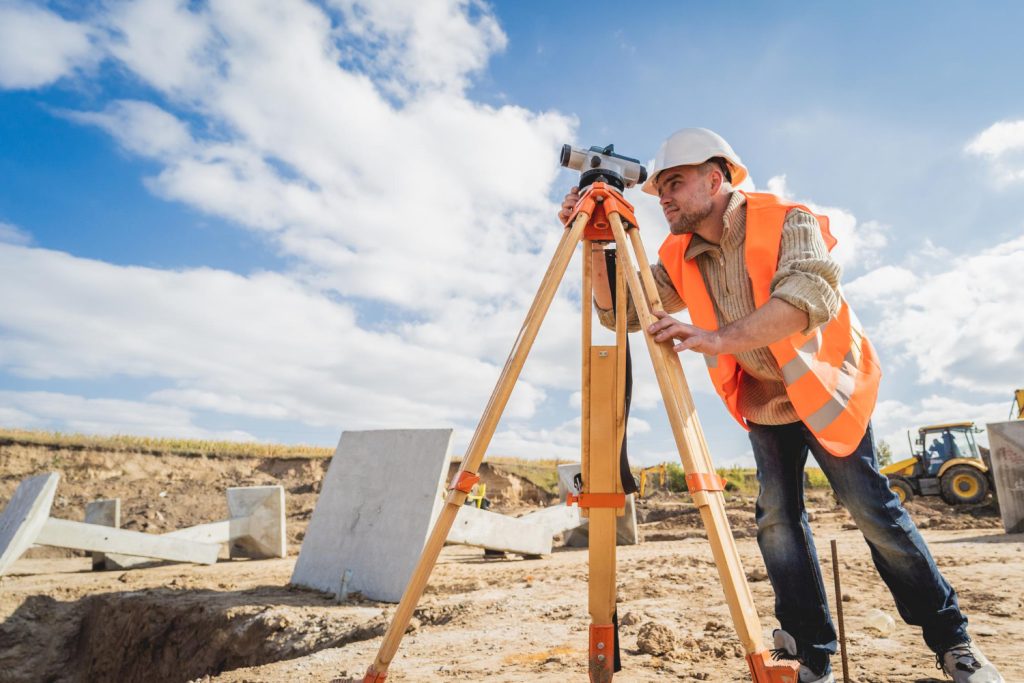
Topographic surveys are conducted by taking precise measurements of the terrain and its features. These measurements are then used to create a map of the land, which typically includes elevation contours, slope measurements, and other features. The surveyor will also record any physical features, such as trees, buildings, roads, and rivers. The surveyor will use specialized equipment, such as a theodolite and a total station, to take the measurements.
The Types of Topographic Surveys

The most common type of topographic survey is the contour line survey. This type of survey is used to measure the elevation of an area and create a contour map. Contour lines are created by connecting points of equal elevation and can be used to determine the terrain of the land. This type of survey is useful for construction projects, land development, and other activities that require an understanding of the land’s topography.
Another type of topographic survey is the spot height survey. This type of survey is used to measure the exact elevation of certain points on the land. Spot heights are used to pinpoint the location of high and low points and can be used to measure the elevation of a particular location. They are often used by engineers and surveyors to determine the best route for roads, waterways, and other infrastructure projects.
A third type of topographic survey is the triangulation survey. This type of survey is used to measure the distance between two points on the land. Triangulation surveys are used to create an accurate map of the land and to measure the elevation of certain points. This type of survey is useful for creating detailed maps of large areas, as well as for accurately measuring the location and elevation of certain points on the land.
Finally, a fourth type of topographic survey is the photogrammetric survey. This type of survey is used to measure the features of a land surface by taking aerial photographs. Photogrammetric surveys are used to create detailed maps and elevation models of a given area. This type of survey is often used for large-scale mapping projects, such as creating detailed maps of large cities or entire states.
Conclusion
Overall, topographic surveys are an essential tool for engineers, architects, and surveyors. They provide an accurate representation of existing terrain and can help to reduce costs associated with a project, as well as improve safety, identify natural resources, and so much more! And, with so many types of topographic surveys to be done, you can pick whichever one you need to fulfill your goals.
Will’s Service Group are expert land surveyors, offering the exact services clients need without any unnecessary costs. If you are looking for topographical surveys in Florida, contact us today!
Understanding types of topographic surveys for land development helps Florida property owners make informed decisions about their land and investments. Contact Will’s Service Group for professional guidance tailored to your specific needs.
Frequently Asked Questions
What are the main types of topographic surveys?
The main types of topographic surveys include planimetric surveys that map horizontal features like roads and buildings, hydrographic surveys that chart water depths and shorelines, geodetic surveys that account for the earth’s curvature over large areas, and ALTA/NSPS surveys that combine topographic data with boundary and title information for commercial real estate. Each type serves a different purpose depending on the project scope and requirements.
What is included in a topographic survey?
A topographic survey includes the measurement and mapping of natural and man-made features on a property. This covers elevation contours, trees, water features, existing structures, driveways, fences, utility poles, manholes, storm drains, slopes, and ground surface conditions. The deliverable is a detailed contour map with spot elevations that engineers and architects use for design and planning.
How is a topographic survey different from a boundary survey?
A boundary survey focuses exclusively on locating and marking property lines based on legal descriptions and recorded deeds, while a topographic survey maps the physical features and elevation changes across a property. A boundary survey answers where your property begins and ends. A topographic survey shows what the ground looks like within and around those boundaries, which is essential for grading, drainage, and construction design.
When do you need a topographic survey in Florida?
In Florida, you typically need a topographic survey before any new construction, major renovation, or site development project. Local building departments often require topographic data to evaluate drainage plans, flood zone compliance, and environmental impact. They are also essential before designing retaining walls, pools, septic systems, and landscape grading plans where accurate elevation data prevents costly drainage problems.